Business Web Apps & Portals for Digital Business Processes
Digital web applications and portals provide a reliable way to structure internal workflows, customer interactions, and partner processes. Wentytech develops custom web applications with role-based access control (RBAC), clear application architecture, and ERP/CRM integration via APIs. The result is high-performance, scalable solutions without media disruptions: processes become more transparent, data more consistent, and teams work more efficiently—while meeting the high standards of operational reliability and data protection expected by Swiss companies.
What Are Business Web Apps and Portals?
Business web apps and portals are web-based applications designed to support business processes, data handling, and user interactions. Unlike traditional corporate websites, their primary focus is not content or marketing, but functionality, process logic, and secure access to business-critical information. Typical use cases include internal applications, customer portals, partner platforms, and administrative interfaces. A business web app combines business logic, data processing, and user interfaces into a single application. User roles, permissions, and workflows ensure controlled access to information and efficient execution of processes. Portals extend this concept to external users such as customers or partners, enabling structured interactions, self-service capabilities, and transparent processes. Wentytech designs business web apps and portals tailored to specific organizational requirements. Scalability, security, and system integration are key priorities. The resulting applications integrate seamlessly into existing IT landscapes and provide a stable foundation for digital business processes that can be maintained and expanded over time—particularly important for Swiss organizations with high standards for data protection and operational reliability.
Why Traditional Websites Are Not Enough for Complex Business Processes
Many organizations attempt to support internal workflows or customer processes using traditional websites, forms, or isolated tools. These approaches quickly reach their limits once business logic, user roles, or cross-system processes are required.
-
Limited functionality and missing process logic
Traditional websites are designed for content delivery, not for complex workflows, approvals, or rule-based processes. -
Lack of granular user roles and permissions
Internal users, customers, and partners cannot be securely separated or managed in detail. -
Manual follow-up despite digital interfaces
Data collected through forms often requires manual processing, leading to errors and inefficiencies. -
Difficult integration with existing systems
Without a proper application architecture, integrations with ERP, CRM, or domain systems are limited or unstable. -
Limited scalability and maintainability
As functionality grows, traditional web solutions become difficult to maintain and pose increasing technical risk.
Clear Application Architecture and Separation of Logic
We design business web apps with a clear separation between frontend, backend, and business logic. This ensures maintainability, scalability, and technical stability as requirements grow.
Role-Based Access and Security Concepts
User roles, permissions, and access controls are built in from the start. Internal users, customers, and partners only see the data and functionality relevant to them.
Seamless Integration into Existing Systems
Business web apps and portals integrate cleanly with existing systems such as ERP, CRM, third-party platforms, or APIs—enabling end-to-end digital processes.
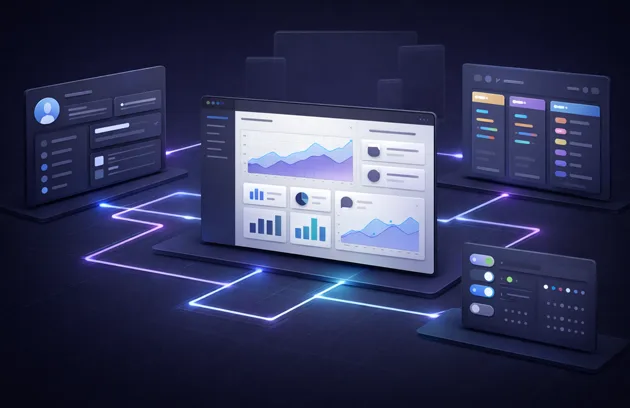
Digital Applications That Truly Support Business Processes
Business web apps and portals provide a centralized digital platform for business processes, data, and user interactions. Clearly defined workflows, roles, and access rights make processes more transparent, efficient, and less error-prone—for both internal teams and external users.
At the same time, the result is a technically clean and scalable solution that remains maintainable over the long term. Changes, extensions, and integrations can be implemented in a controlled manner without compromising existing functionality, allowing business web apps to evolve with organizational needs.
Business Web Apps & Portals: Typical Application Areas
Internal business applications
Web-based applications supporting internal processes such as approvals, data management, reporting, or operational workflows—centralized, secure, and role-based.
Customer portals with self-service capabilities
Portals that allow customers to access data, documents, and status information or perform requests and transactions without manual intervention.
Partner and supplier portals
Structured platforms for partners or suppliers to collaborate, exchange data, and execute processes through defined access controls and integrations.
Custom administrative and line-of-business applications
Tailored web apps supporting specific business units, including integration with ERP, CRM, or third-party systems.
Trusted Business Web Apps Built to Swiss Quality Standards
Wentytech designs business web apps and portals with a strong focus on stability, security, and long-term maintainability. Our solutions are built on clean architecture, clear responsibility boundaries, and proven development practices—ensuring reliable operation even as user numbers and functional complexity grow.
As a Swiss technology partner, we address data protection, access control, and operational requirements from the outset. User roles, security concepts, and integrations are implemented and documented in a transparent manner. This builds trust in web applications that support business-critical processes and can be operated sustainably over time.
FAQ – Business Web Apps & Portals
How do business web apps differ from traditional websites?
Business web apps implement business logic, processes, and user roles. Unlike traditional websites, they focus on functionality, data handling, and system integration.
Are business web apps only suitable for large enterprises?
No. SMEs also benefit from custom web apps and portals, especially for digitizing internal workflows, customer processes, or partner interactions.
Can existing systems be integrated?
Yes. Business web apps and portals are integrated with existing systems such as ERP, CRM, or external APIs to enable end-to-end processes.
How are security and access control handled?
Access is role-based with clearly defined permissions. Security concepts, authentication, and data protection are built in from the start.
Are the applications scalable and extensible?
Yes. The architecture is designed to support new features, user groups, and integrations in a controlled and sustainable way.
Ready for custom business web apps and portals?
Discuss how a tailored web app or portal can support and digitize your business processes—practical and without obligation.
Discuss web app projectFree · 30 min · Evaluate web app potential